Introduction
In which this blog introduces itself
JESSE: Hi, my name is Jesse, and I’m a Sorkin addict.
VOICES FROM THE ETHER: Hi, Jesse…
It all started after I graduated high school, so I suppose you could say I’m something of a neophyte. Nonetheless, I can say that I have seen every work credited to Aaron Sorkin adapted for the screen multiple times — I’ve even lost count on most of them. There’s just something about the natural rhythm and musicality of what he writes that has me coming back to it all more often than a human being should ever come back to anything. Having seen it all so often, of course, grants me a certain amount of perspective on the writer.
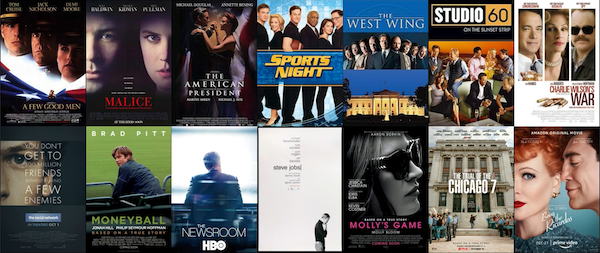
To date, Mr. Sorkin has written for four TV shows and received writing credit on ten movies. Of those four TV shows, three of them… are about TV shows, as is one of his movies. The remaining TV show takes place inside the US government, as do two of his movies. Five of the remaining movies have at least one scene that takes place inside a deposition or a court room — and seven of his movies are biopics retelling the stories of historical figures or events.
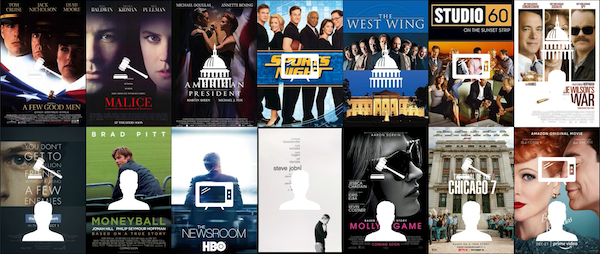
So, yeah… it’s fair to say that Sorkin works can be quite similar. If you’re a Sorkin fan, however, that’s not necessarily the first thing you think of in terms of inter-work similarity.
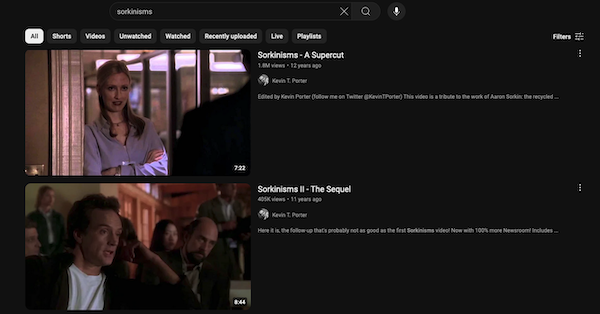
Chances are, if you’ve arrived at this blog on purpose, you’ve watched the Sorkinisms videos put together by Kevin T. Porter, showcasing a number of times Mr. Sorkin has reused dialogue or implemented signature verbal or physical tics in his works for the screen. It shouldn’t surprise you, however, that those videos are incomplete in showing how much Mr. Sorkin tends to reuse dialogue or plot ideas.
As such, I decided to go through all his on-screen works and compile a document on all the Sorkinisms I could catch from having watched everything multiple times. The act of doing so revealed north of 400 different elements that I thought could reasonably be considered Sorkinisms.
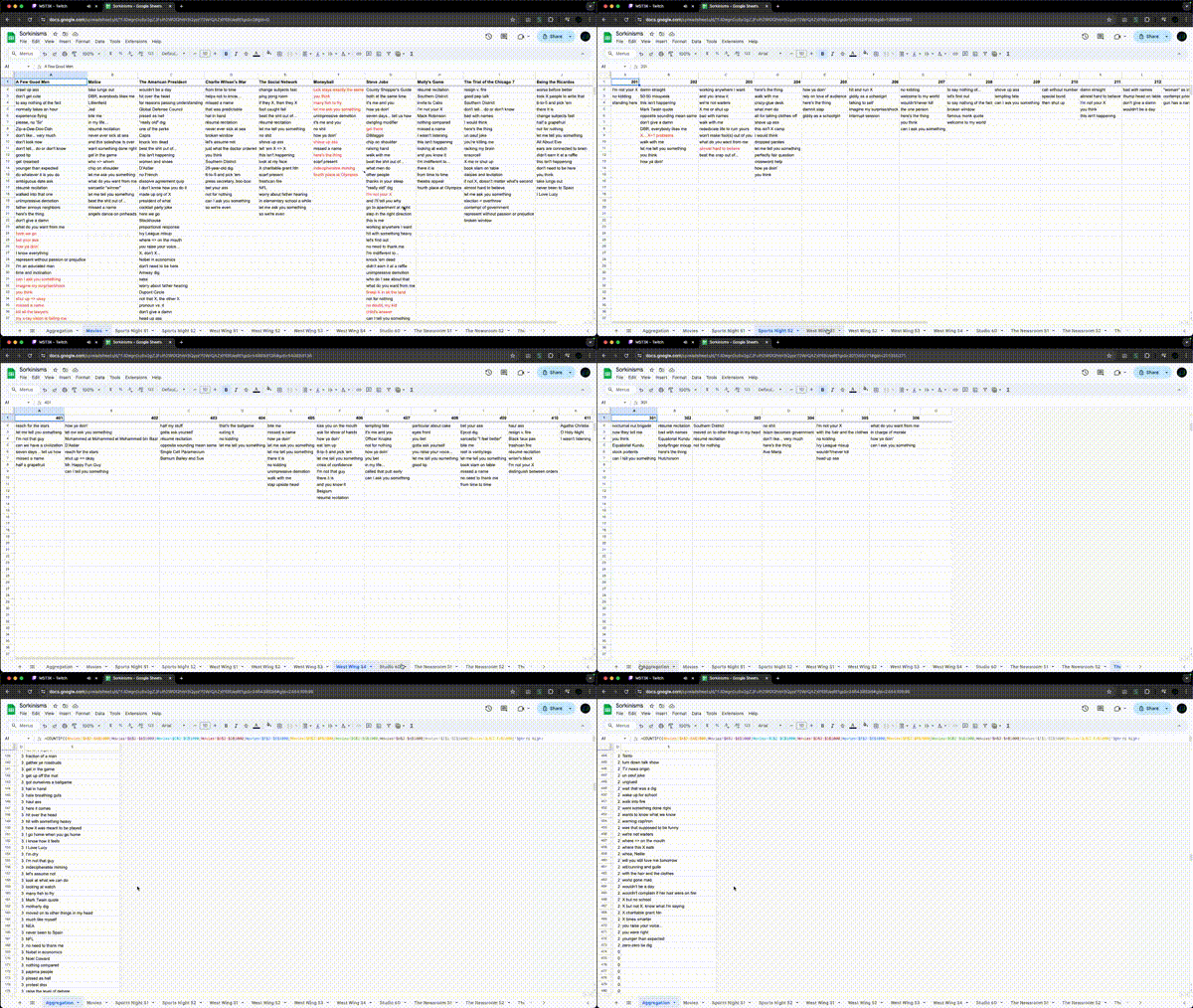
Yeah… you can see why I called myself an addict at the top. (Either that or an undiagnosed autist, but like that would make a difference at this point in my life.)
My first thought was to take all this data and set up a Sorkinisms wiki to be able to link everything together. The sticking point for me that made the idea a difficult one was the necessity to have video evidence for each instance available on each page, which would have been a rather tedious undertaking. Instead, I decided to have some fun with it and start a project that I’m calling… Sorkin Exegesis.

Through this blog, I will step through every Sorkin work for the screen and point out Sorkinisms where they occur. Since that by itself would be rather boring, however, I will additionally provide my own commentary on the text of each work — hence the name of the project. It would also behoove me to point out where Mr. Sorkin has reused actors as well, since he is arguably just as notorious for that as he is for his dialogue. Some of the works I’ll be going through even have publicly available draft or shooting scripts, so I’ll have some fun analyzing the differences between those scripts and the final products. Who knows — maybe I’ll even venture into the apocrypha of his script doctor work.
(It just occurred to me as I’m writing this introduction that the project name could potentially be considered an underhanded reference to Mr. Sorkin being a non-practising Jew? I swear, that wasn’t on purpose.)
My hope for this project is that it will eventually serve as something of a living document as more Sorkin works are released for the screen. To start, though, I will need to catch up on ten movies and 180 television episodes. Here’s hoping I make it…
Let’s establish some ground rules on how I expect to format posts for this project. To start, each entry will begin with a set of header lines indicating the name of the work, the date of its premiere/airing, any additional writing credits if applicable, the directing credit for the work, and a link to any public available draft or shooting script for the work if it exists. From there, the entry will present any quotes from the work in a blockquote format to differentiate them from the commentary text. Every Sorkinism found will be explicitly headered with a slugline indicating whether it is a NEW or RETURNING Sorkinism and the type of that Sorkinism, followed by a listing of previous instances of that Sorkinism. The types of Sorkinisms to expect are the following:
- Dialogue Motif: a piece of dialogue Mr. Sorkin has written that ended up being used in multiple works
- Plot Bunny: a plot idea Mr. Sorkin has used across multiple works
- Topical Signature: a topic of discussion Mr. Sorkin has brought up in multiple works
- Verbal Tic: a turn of phrase Mr. Sorkin uses so often that calling out each individual instance would become unwieldy, so as such will have its header provide a running count of that tic instead of a previous instance listing
- Non-Verbal Signature: a physical action Mr. Sorkin has brought about on multiple occasions (yes, there are examples of that)
- Sorkin Name: a character name (whether on screen or off) which Mr. Sorkin has used for multiple characters across works
- Sorkin Drink: a beverage brand Mr. Sorkin has shown a proclivity to name-drop across multiple works (no, I’m not joking)
- Sorkin Player: an actor who has appeared in multiple Sorkin works for the screen
As the works analyzed call for it, some additional formatting may be introduced to service the needs of the commentary. For now, the above should be largely what to expect going forward.
Be sure to subscribe to this blog so you’ll be among the first to know when each new post comes out. First up: a crash course in reasonable doubt.
Comments powered by Disqus.